
 Barion
Problem & approach
Learners working with source-heavy material need to check where an answer came from and return to a review schedule. Neither action should depend on a cloud account or an available AI provider.
I combined a local source library, evidence-linked cards and FSRS scheduling. Local extraction provides baseline candidates; an optional Python gateway adds AI-assisted generation and retrieval. Candidates still need human review.
- 01
Add a source
Text or a selectable-text PDF.
- 02
Inspect candidates
Review content and source links.
- 03
Study & rate
Reveal, rate and schedule locally.
Inside the application
Read the interface
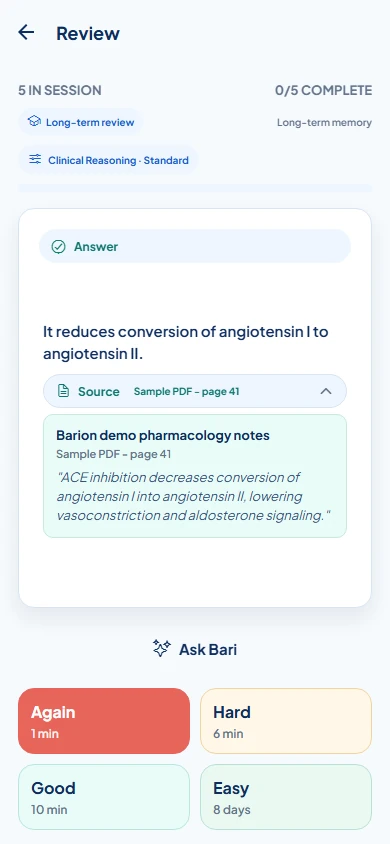
A card with a way back to its source.
Current local web preview, captured 16 November 2026 at mobile width. Built-in sample data; not a native release or medical advice.
 Enlarge image
Rate the recalled answer.
Again, Hard, Good and Easy appear after revealing. The rating supplies the scheduler with the learner’s review response.
More application captures (1)
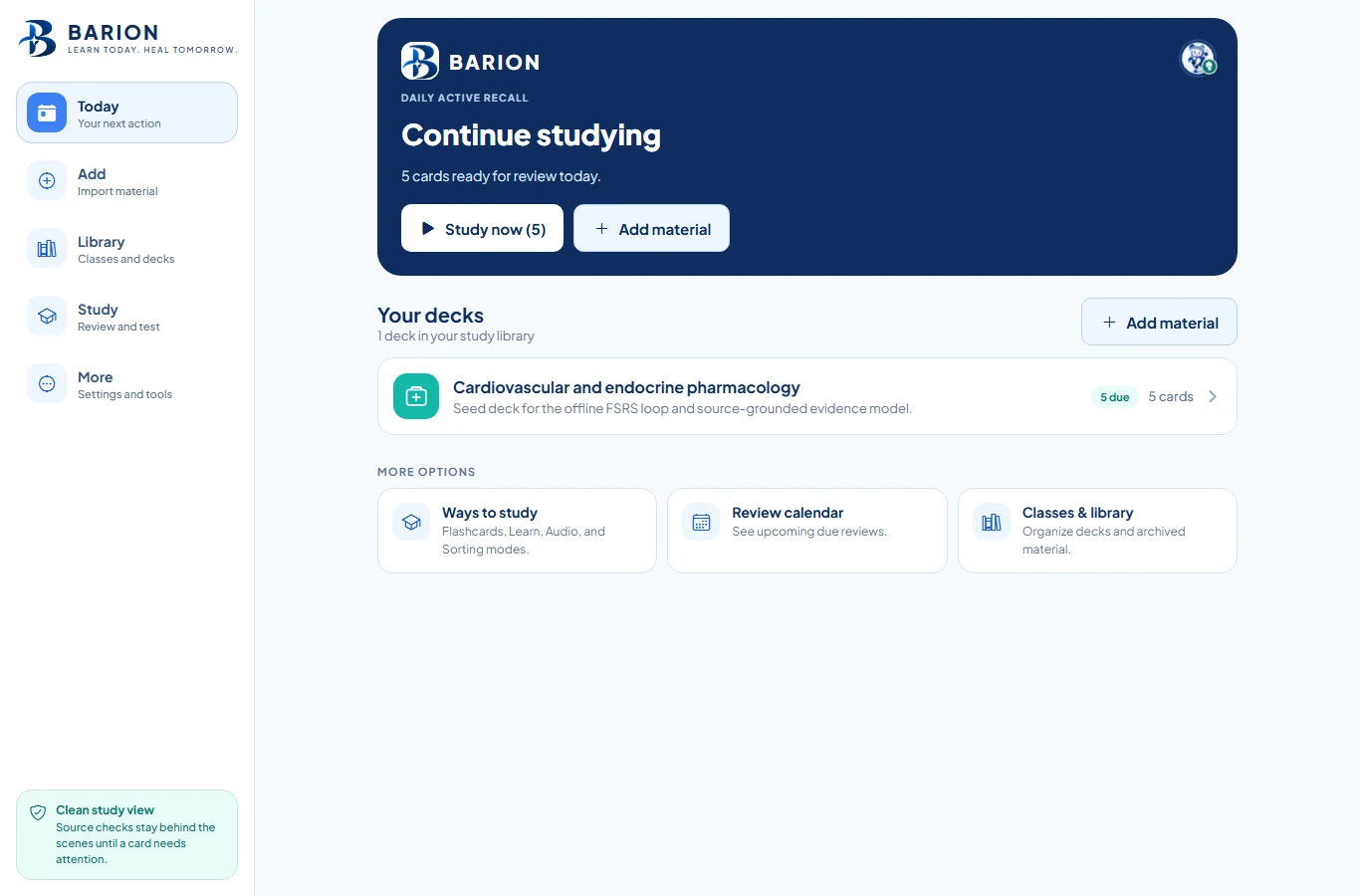
Watch the actual review workflow Silent video
What happens in the recording
- Open Study now from the dashboard.
- Attempt recall, then select Reveal.
- Expand Source to inspect the sample excerpt behind the answer.
- Select Good; the application advances to another review card.
Actual local web preview · 16 November 2026 · Silent recording · Built-in sample deck. This is not a native-release or medical-content validation.
Download recording (WebM, 760 KB)- TraceFollow a card’s source segments to inspect the evidence behind it.
- ReviewRate an answer to update its next review through TS-FSRS.
- RetainKeep sources, cards and review events in local SQLite storage.
System architecture
React Native / Expo application
Source library, cards and review controls
Read / write locally
SQLite + TS-FSRS
Sources, cards, ratings and scheduler state
Cards & next review
Optional generation request
Python / FastAPI
Retrieval → configured provider → validation
Candidates with provenance
Explore the failure path
Behind the interface / 02
Illustrative walkthroughWhat happens if the AI service is unavailable?
Reviewing saved cards and generating new candidates are separate responsibilities.
Saved cards & reviews
SQLite and the local scheduler support the existing study loop.
Available locallyAI-assisted generation
An optional gateway requests source-grounded candidates.
Optional remote pathA service can help without owning the study loop. Configured generation can request remote candidates. Reviewing cards already stored on the device does not depend on that service.
Read the scenario & implementation limits
If the optional AI service is unavailable, saved-card review remains local. Generation can use the extractive fallback for valid, supported input; this does not guarantee a useful result for every source. Local review requires cards already on the device.
This source-based illustration makes no network calls, does not change your connection and is not a live test or guarantee of release readiness. Public source snapshots may precede the audited local changes.
- TypeScript
- React Native
- Expo
- SQLite
- Python


Engineering decisions
Keep the source attached
I carry source-span provenance into generation so a learner can inspect the underlying material. A citation explains origin; it does not prove the answer is correct.
Source: Generation and provenance (opens in a new tab)Make scheduling replayable
I serialize scheduler state and retain review ratings. Replaying the same history can reproduce the next state, making scheduling behavior testable.
Source: FSRS adapter (opens in a new tab)Implementation in focus
Keep fallback output distinguishable
- Problem
- A provider failure must not turn locally extracted cards into apparently successful AI output.
- Implementation
- The generation path returns fallback provenance with locally extracted candidates. This is an explicit alternative path, not an on-device language model.
Verification & status
7 scheduling and generation tests passed
15 November 2026 · 2 Jest suites · Local working tree
Seven tests passed across two suites covering scheduling, deterministic replay, generation contracts and fallback provenance. Provider behavior was stubbed; these were not live AI-service checks.
The tested adapter files match the public revision, but their working-tree dependencies may differ. These checks do not establish native-release readiness or learning quality.
Download verification record (JSON)In development
Local persistence, source-linked review, scheduling and optional generation services are implemented. The application remains in development; native store releases and production services are not established here.
The recording demonstrates one local web review path, not a native release. Independent content review, evaluator calibration and native-device checks remain open.
Lessons & next steps
I separate everyday review from generation availability, and traceable provenance from content quality. Keeping those boundaries explicit makes failures easier to explain without overstating what the system verifies.
Validate backup and study on a native device, review generated material independently, and verify production service configuration.
Explore the implementation
Source links are pinned to public commit 7e83b70. Tests and media use a newer local working tree; neither is presented as a clean-public-commit release check.